Overall results from the VIP-study (2011-2017)
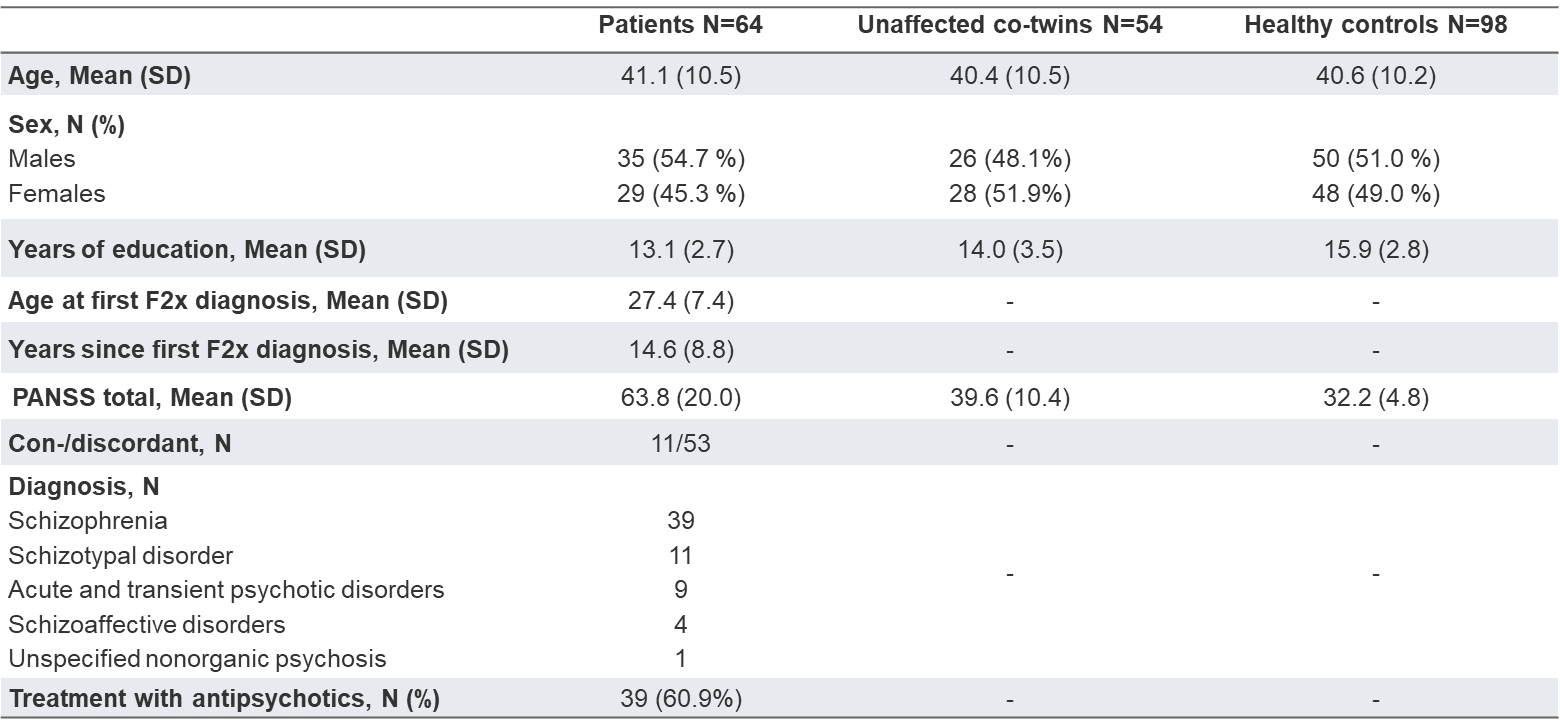
The overall aim of the study was to undercover how genetic and environmental factors influence the development of schizophrenia, cognitive deficits, and brain abnormalities. A total of 216 twins participated in the clinical investigations, including monozygotic (MZ) and dizygotic (DZ) proband pairs (one or both twins had a schizophrenia spectrum diagnosis) as well as psychiatric healthy control twin pairs matched on sex and age. We examined a wide range of risk factors for schizophrenia through blood tests, questionnaires, interviews, neuropsychological tests, and an MRI scan of the brain.

In the first part of the study, we showed that schizophrenia is a highly heritable disorder.
We found that early age at illness onset compared to later onset in the first diagnosed twin was a major risk factor for developing schizophrenia in the second twin. In addition, early onset schizophrenia was linked to a more severe genetic predisposition. However, the genetics are complex and do not explain everything, as many environmental factors also increase the risk of developing schizophrenia. In this study, we saw that childhood trauma and regular cannabis use play a crucial role in the development of this disorder.
In the second part of the study, we examined cognitive deficits and abnormalities in various brain measures. Many individuals with schizophrenia experience pronounced cognitive deficits, such as poor memory, concentration, or mental flexibility. Here we showed that many cognitive functions are heritable, although to varying degrees. Additionally, we found a genetic link between cognitive difficulties and schizophrenia, which suggest that some of the genes affecting the risk of developing the disorder are also involved in our cognitive functioning. Moreover, we found that the size of many brain regions, the level of glutamate (an important neurotransmitter in the brain), and blood flow in key brain areas are also heritable and related to schizophrenia.
In summary, the results highlight the importance of developing treatments specifically targeting cognitive deficits and brain changes. Furthermore, the results show that environmental factors play a crucial role in the vulnerability to and clinical manifestation of a schizophrenia spectrum disorder. These findings emphasize the importance of preventive work and education in this area by clearly advising against cannabis use in individuals at high risk of developing a psychotic disorder, especially those with experiences of childhood trauma.
Publications
- Rasmussen, Frokjaer, Hilker, Madsen, Anhøj, Oranje, Pinborg, Glenthøj & Knudsen (2016). Low frontal serotonin 2A receptor binding is a state marker for schizophrenia? European Neuropsychopharmacology, 26, 1248-1250. http://dx.doi.org/10.1016/j.euroneuro.2016.04.008
- Hilker, Helenius, Fagerlund, Skytthe, Christensen, Werge, Nordentoft & Glenthøj (2017). Is an Early Age at Illness Onset in Schizophrenia Associated With Increased Genetic Susceptibility? Analysis of Data From the Nationwide Danish Twin Register. EBioMedicine 18, 320-326. http://doi.org/10.1016/j.ebiom.2017.04.002
- Hilker, Helenius, Fagerlund, Skytthe, Christensen, Werge, Nordentoft & Glenthøj (2018). Heritability of Schizophrenia and Schizophrenia Spectrum Based on the Nationwide Danish Twin Register. Biological Psychiatry, 83:492–498. http://dx.doi.org/10.1016/j.biopsych.2017.08.017
- Legind, Broberg., Brouwer, Mandl, Ebdrup, Anhøj, Jensen., Hilker, Fagerlund, Hulshoff Pol, Glenthøj & Rostrup (2019). Heritability of Cerebral Blood Flow and the Correlation to Schizophrenia Spectrum Disorders: A Pseudo-continuous Arterial Spin Labeling Twin Study. Schizophrenia Bulletin. 45, 6, https://doi.org/10.1093/schbul/sbz007
- Legind, Broberg, Mandl, Brouwer, Anhøj, Hilker, Jensen, McGuire, Hulshoff Pol, Fagerlund, Rostrup, & Glenthøj (2019). Heritability of cerebral glutamate levels and their association to schizophrenia spectrum disorders: A 1 [H]-spectroscropy twin study. Neuropsychopharmacology, 44, p. 581–589. https://doi.org/10.1038/s41386-018-0236-0
- Lemvigh, Brouwer, Pantelis, Jensen, Hilker, Legind, Anhøj, Robbins, Sahakian, Glenthøj & Fagerlund (2020). Heritability of Specific Cognitive functions and Associations to Schizophrenia Spectrum Disorders using the CANTAB: A Nation-Wide Twin Study. Psychological Medicine, 1-14. https://doi.org/10.1017/S0033291720002858
- Lemvigh, Brouwer, Baruël Johansen, Hilker, Pantelis, Glenthøj & Fagerlund (2020). Heritability of Memory Functions and Related Brain Volumes: A Schizophrenia Spectrum Study of 214 Twins. Schizophrenia Bulletin Open, 1 (1), 1-11. https://doi.org/10.1093/schizbullopen/sgaa066
- Lemvigh, Brouwer, Hilker, Anhøj, Baandrup, Pantelis, Glenthøj & Fagerlund (2021). The relative and interactive impact of multiple risk factors in schizophrenia spectrum disorders: A combined register-based and clinical twin-study. Psychological Medicine, 1–11. https://doi.org/10.1017/S0033291721002749
- Lemvigh, Glenthøj & Fagerlund. A Nation-Wide Twin Study of Social Cognition in Schizophrenia Spectrum Disorders. Schizophrenia, 8, 12 (2022). https://doi.org/10.1038/s41537-022-00223-1
- Nielsen, Rostrup, Hilker, Legind, Anhøj, Robbins, Sahakian, Fagerlund, and Glenthøj (2023) Reward Processing as an Indicator of Vulnerability or Compensatory Resilience in Psychoses? Results From a Twin Study. Biological Psychiatry Global Open Science, 3, Issue 1. https://doi.org/10.1016/j.bpsgos.2022.01.002