Aim
The study aims to uncover multimodal predictors of psychosis development and everyday functioning.
Method
A total of 1000 people at ultra-high risk (UHR) for psychosis are included in the study and followed for two years. A total of 50 UHR participants are included from the Danish site along with 15 healthy controls. The patients are followed closely (monthly) with clinical ratings. Cognitive and biological examinations are carried out quarterly. The study includes, among other things, assessment of positive and negative symptoms, self-disorders, neuro- and social cognition, MRI scans, and blood tests.
Participants
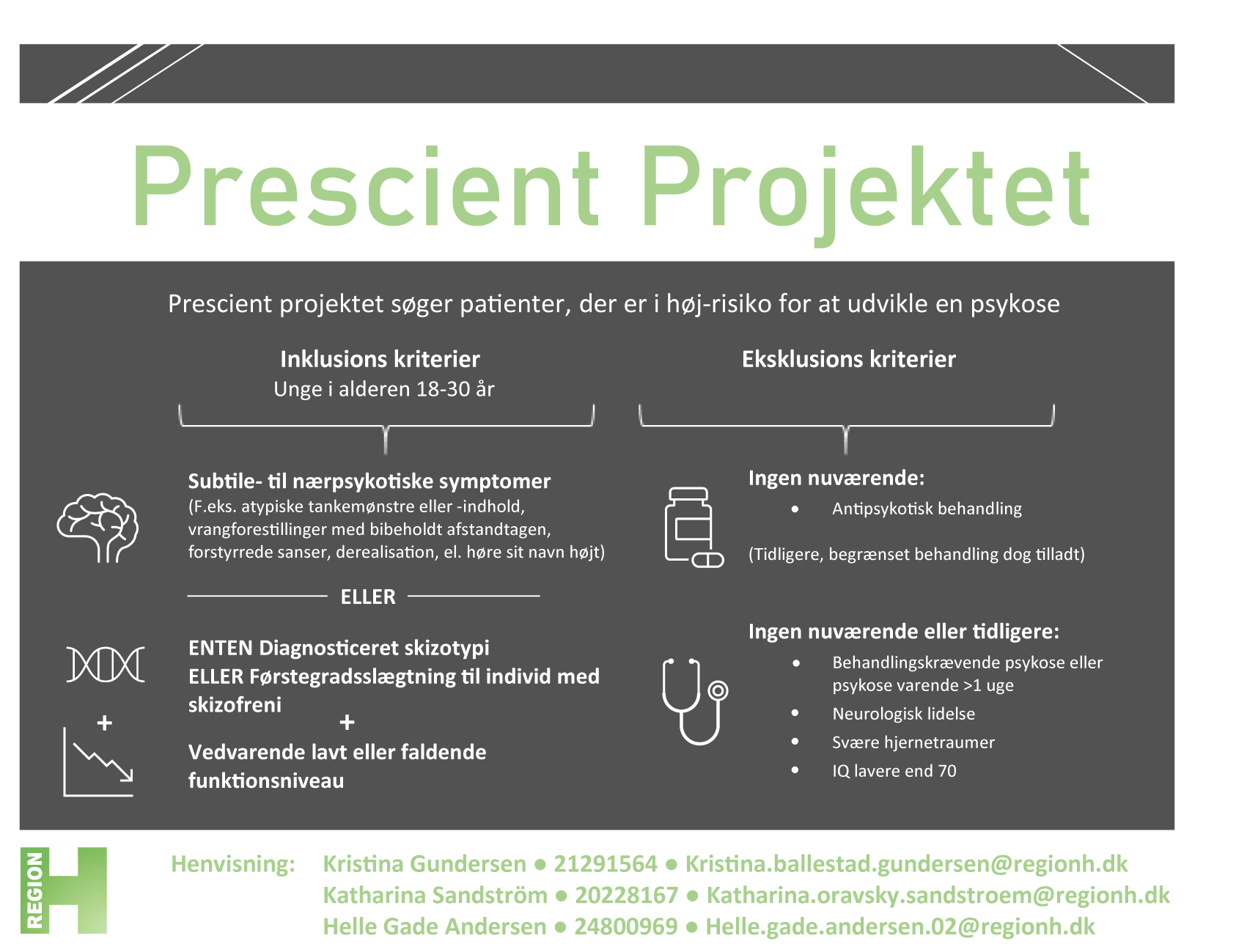
Inclusion criteria are young adults (18-30 years) who experience brief intermittent psychotic symptoms, attenuated psychotic symptoms, or have a vulnerability to the development of psychosis.
Healthy controls must not meet UHR criteria or have a current or past Cluster A personality disorder or be receiving any current treatment with psychotropic medication or have a family history (in first-degree relatives) of psychotic spectrum disorders. Exclusion criteria for both the UHR group and healthy controls are as follows: use of antipsychotic medication exposure equivalent to a total lifetime of haloperidol dose of >50 mg, documented history of intellectual disability or past or present neurological disorder or traumatic brain injury or current or past psychotic disorder.
Perspectives
If there are significant predictors for psychosis development and everyday functioning, it can help to advance risk calculations in UHR groups, which can delay or mitigate the development of psychosis. Furthermore, it can help to optimize and target intervention measures in UHR groups.
Contact
M.D. Helle Gade Andersen, Ph.d. student, e-mail: helle.gade.andersen.02@regionh.dk
Cand.psych. Kristina Ballestad Gundersen, Ph.d. student, e-mail: kristina.ballestad.gundersen@regionh.dk
Funding
PRESCIENT is funded by the National Institute of Health (NIH), USA. The lead PI is Professor Barnaby Nelson from Orygen Research Centre, Melbourne, Australia. At the Danish subsite, the PIs are Associate professor Louise Birkedal Glenthøj and Professor Merete Nordentoft from Copenhagen Research Center for Mental Health, Mental Health Centre Copenhagen, and Professor Bjørn Ebdrup from Center for Neuropsychiatric Schizophrenia Research, Mental Health Centre Glostrup.